Methylene Blue is a phenothiazine compound first synthesized in 1876. At low pharmaceutical doses (typically 0.5 to 4 mg per kilogram of bodyweight), it acts as an electron donor in the mitochondrial electron transport chain (ETC). This is the engine room of cellular energy production, where the molecule ATP is generated.
What the electron transport chain actually does
Every cell in the body relies on mitochondria (the small organelles often called the cell's power plants) to turn nutrients into usable energy. Inside each mitochondrion, electrons hop down a series of four protein complexes (the ETC), pumping protons across the inner membrane. That proton gradient drives the synthesis of ATP, the universal energy currency of the cell.
When the ETC is sluggish (due to age, oxidative stress, or compromised cells), energy production drops. Symptoms range from mental fog to physical fatigue.
Methylene Blue as an alternative electron carrier
Methylene Blue can bypass a stalled section of the ETC by directly donating electrons to complex IV (cytochrome c oxidase). In effect, it offers a shortcut for cells whose normal electron flow has been disrupted. This mechanism is well-characterized in biochemistry literature and is the foundation for Methylene Blue's interest in clinical and research contexts.
Why dose matters
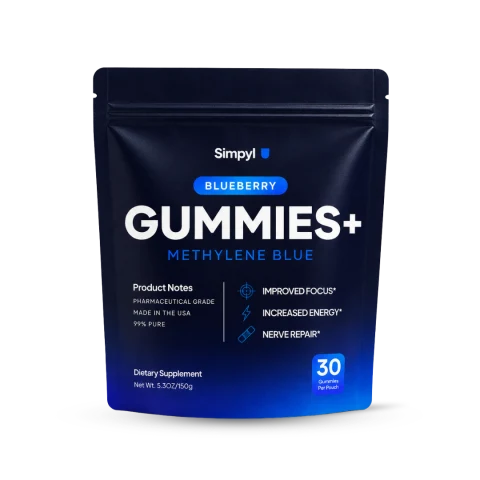
At low doses (under ~5mg/kg), Methylene Blue acts as a net electron donor, supporting energy production. At higher doses (above ~7 mg/kg), the same molecule can flip and become a pro-oxidant, generating reactive oxygen species. This hormesis curve is why our Methylene Blue gummies are precision-dosed at 5mg per serving, well within the supportive range and far below any pro-oxidant threshold.
What this means in practice
Consistent low-dose Methylene Blue supports cellular energy production, particularly in tissues with high metabolic demand like the brain. Users typically report sustained mental clarity within 30–60 minutes of their first dose, with cumulative benefits over 2–3 weeks of daily use as mitochondrial efficiency adapts.
This is fundamentally different from how caffeine or other stimulants work. Caffeine blocks adenosine receptors to mask fatigue. Methylene Blue supports the underlying energy production machinery, which is why there's no crash when it wears off.
Important caveats
- Methylene Blue can interact with serotonergic medications (SSRIs, MAOIs). Consult your physician before combining.
- Quality varies dramatically. Industrial-grade and aquarium-grade Methylene Blue contain contaminants that have no place in something you ingest. Our gummies use >99% pure Methylene Blue with third-party purity testing on every batch.
- This article describes mechanisms supported by published research. It is not medical advice and has not been evaluated by the FDA.
Sources
- Atamna H, Nguyen A, Schultz C, et al. (2008). Methylene Blue delays cellular senescence and enhances key mitochondrial biochemical pathways. FASEB Journal, 22(3), 703–712.
- Wen Y, Li W, Poteet EC, et al. (2011). Alternative mitochondrial electron transfer as a novel strategy for neuroprotection. Journal of Biological Chemistry, 286(18), 16504–16515.
- Tucker D, Lu Y, Zhang Q. (2018). From mitochondrial function to neuroprotection: an emerging role for Methylene Blue. Molecular Neurobiology, 55(6), 5137–5153.
- Riha PD, Bruchey AK, Echevarria DJ, Gonzalez-Lima F. (2005). Memory facilitation by Methylene Blue: dose-dependent effect on behavior and brain oxygen consumption. European Journal of Pharmacology, 511(2-3), 151–158.
- Callaway NL, Riha PD, Bruchey AK, et al. (2004). Methylene Blue improves brain oxidative metabolism and memory retention in rats. Pharmacology Biochemistry and Behavior, 77(1), 175–181.