"No crash" is the most common phrase users use to describe the felt experience of low-dose Methylene Blue. To understand why, it helps to look at how stimulant energy and metabolic energy actually differ at the cellular level.
How caffeine produces energy (it doesn't, really)
Caffeine doesn't give the body energy. It blocks adenosine receptors in the brain. Adenosine is the molecule that builds up during the day and signals fatigue. When caffeine displaces it, the brain stops getting the "you're tired" signal. The result feels like more energy.
The problem: adenosine keeps building up while caffeine is blocking the receptors. Once caffeine wears off, all that accumulated adenosine binds at once. That's the crash.
How Methylene Blue produces energy (it actually does)
Methylene Blue supports ATP production directly by acting as an electron donor in the mitochondrial electron transport chain. Cells with sluggish ETCs become more efficient. More ATP is generated from the same fuel inputs. The brain, which uses about 20% of the body's energy at rest, particularly benefits.
There's no receptor blocking, no debt to pay off, no neurotransmitter signal being masked. The result feels like genuinely more available energy because that's what it is.
What sustained energy actually feels like
Users report:
- Steady focus from morning through mid-afternoon
- No 2–3 PM crash that requires another stimulant to push through
- Better sleep quality (because adenosine cycles aren't disrupted)
- Compatible stacking with coffee. Methylene Blue doesn't compete with caffeine; it operates on a completely different mechanism
The trade-off: the felt effect is less dramatic than a strong espresso. There's no "punch." It's more like the absence of fatigue than the presence of stimulation.
The daily ritual approach
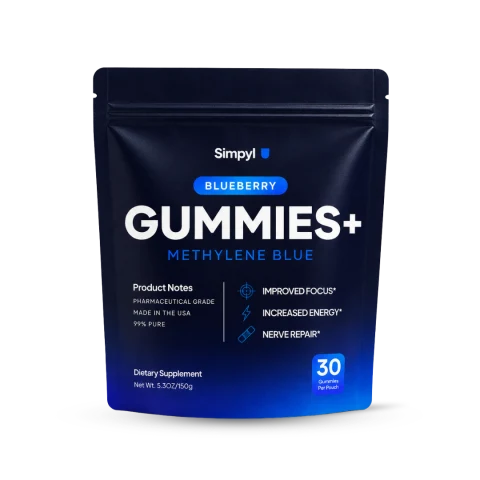
Because Methylene Blue's benefits compound over time as mitochondrial efficiency adapts, single doses produce less obvious effects than daily use over 2–3 weeks. Our Methylene Blue gummies at 5mg per serving are formulated for this daily-use case rather than one-off bursts.
The typical protocol our users report:
- One gummy in the morning, ideally on an empty stomach
- Coffee or breakfast 15–30 minutes later if desired
- Consistent daily use for at least 2 weeks before evaluating
- Skip if you're on SSRIs, MAOIs, or other serotonergic medications without consulting a physician
Why our Methylene Blue is dosed where it is
5mg per gummy keeps each daily dose comfortably within the electron-donor range. Higher doses (50+ mg) flip the molecule into pro-oxidant territory, generating the kind of reactive oxygen species the body works hard to neutralize. Lower doses can be insufficient for sustained effect.
Verified >99% purity with third-party batch testing means there are no industrial contaminants, no heavy metals at meaningful levels, and a documented Certificate of Analysis available on request.
This article describes the mechanism of action and personal-use patterns. It is not medical advice. Statements about our product have not been evaluated by the FDA.
Sources
- Atamna H, Kumar R. (2010). Protective role of Methylene Blue in Alzheimer's disease via mitochondria and cytochrome c oxidase. Journal of Alzheimer's Disease, 20 Suppl 2, S439–S452.
- Poteet E, Winters A, Yan LJ, et al. (2012). Neuroprotective actions of Methylene Blue and its derivatives. PLOS ONE, 7(10), e48279.
- Rojas JC, Bruchey AK, Gonzalez-Lima F. (2012). Neurometabolic mechanisms for memory enhancement and neuroprotection of Methylene Blue. Progress in Neurobiology, 96(1), 32–45.
- Riha PD, Rojas JC, Gonzalez-Lima F. (2011). Beneficial network effects of Methylene Blue in an amnestic model. NeuroImage, 54(4), 2623–2634.
- Schirmer RH, Adler H, Pickhardt M, Mandelkow E. (2011). Lest we forget you, Methylene Blue. Neurobiology of Aging, 32(12), 2325.e7–2325.e16.